
Insights
Training
On-demand



We share the results of our IT support survey, in partnership with Avast, and explore the challenges facing the charity sector



Charities have faced multiple crises over the years, balancing an unpredictable economic climate with rising demand for their services. In a fast-paced digital world, it can be easy for their day-to-day reality to get overlooked, for digital systems to become outdated, and for skills to become stagnant.
For this reason, cyber security experts Avast and Charity Digital launched a survey to discover more about the digital challenges charities face and shape IT support. The survey delved into the most common technical requests charities receive and looked at how much time is spent on solving these issues on average.
Below, we explore some of the most important findings from the survey, along with a helpful infographic to share with your teams.
For most charity respondents, IT support is outsourced, with more than a third (36%) saying an outsourced IT provider helps them with tech and IT issues. Three in ten said a volunteer helped them, while just 12% had a Head of IT or IT manager responsible for helping them with their tech issues.
This reflects research that shows only 15% of charities say they have adequate internal resource to support their digital strategy. Many small and medium-sized charities, who have further reduced budgets and resource to draw from, may find it particularly difficult to implement new tools and modernise their operations, especially without dedicated IT support.
The survey also revealed that device management was the most common IT request received from volunteers and staff over the previous 12 months, with 56% of respondents saying they experienced this. Issues logging into a device or account were the second most cited IT request (45%), followed by internet issues (42%), implementing new software (41%), and printing issues (39%).
Most concerning, however, is the amount of time spent on tackling these issues. More than half of charities said they had requested technical support or assistance more than five times in the previous year – 28% had required support more than 10 times.
On a monthly basis, the outlook was slightly more promising. More than half of respondents said they spent less than five hours a month solving technical problems. However, that still leaves 44% of respondents who spent more than five hours on these issues.
More than a quarter (26%) said they spent between five and 10 hours on solving technical problems, while almost one in ten spent between 11 and 20 hours. The same proportion was dedicating more than 20 hours, so it is easy to see how whole days can be lost to issues with digital technology, time that charities simply do not have to spare.
To find out more about the current state of IT support in the charity sector, download the infographic below. We encourage charities to share the infographic with their leaders and teams to better shape their support and locate free or discounted resources that can help, like the Avast Academy.
Follow-up questions for CAI
How can charities effectively outsource IT support to improve efficiency?What strategies help charities reduce time spent on common IT issues?How does volunteer IT support impact charity digital transformation?Which cyber security measures best protect small and medium charities?What role does leadership play in advancing charity digital strategies?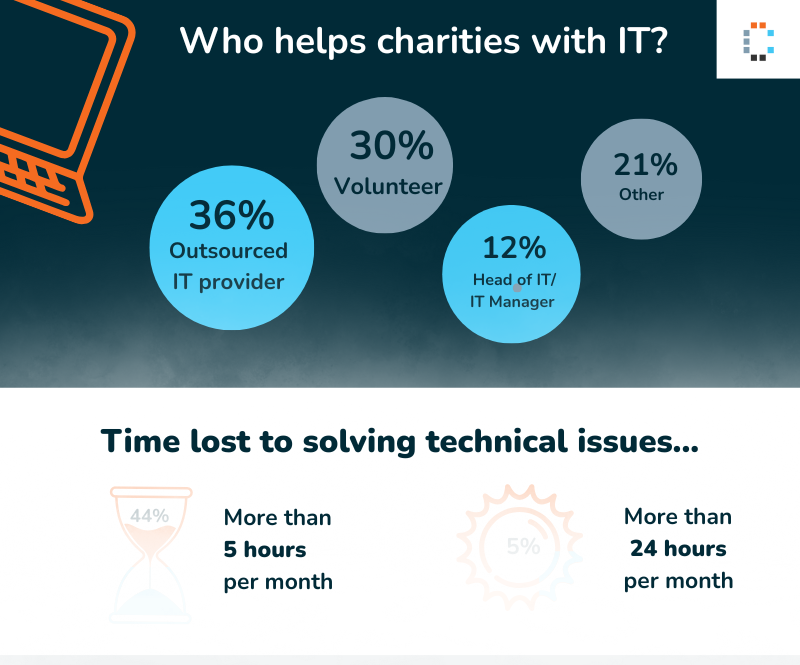
Click below to download the infographic summarising the results from the Avast IT support survey






Our courses aim, in just three hours, to enhance soft skills and hard skills, boost your knowledge of finance and artificial intelligence, and supercharge your digital capabilities. Check out some of the incredible options by clicking here.

© 2022 Charity Digital Trust. All rights reserved