Insights
Training
On-demand



We recap an interesting session at the Charity Digital AI summit, exploring how AI can help create better supporter journeys to boost fundraising and drive engagement



Presented at the Charity Digital AI Summit by Cath Biddle, Director of Digital and Data at Breast Cancer Now, Lou Barton Strategy Principal Consultant - Engagement and Dom Cechova, Digital Marketing Strategist at manifesto
The widespread adoption of Artificial Intelligence (AI) is fundamentally changing how organisations operate across almost every sector imaginable. For charities the technology can offer opportunities to enhance supporter experiences.
This transformation comes at a time when the traditional marketing funnel has evolved into a complex ‘swirl,’ as demonstrated in the diagrams below:
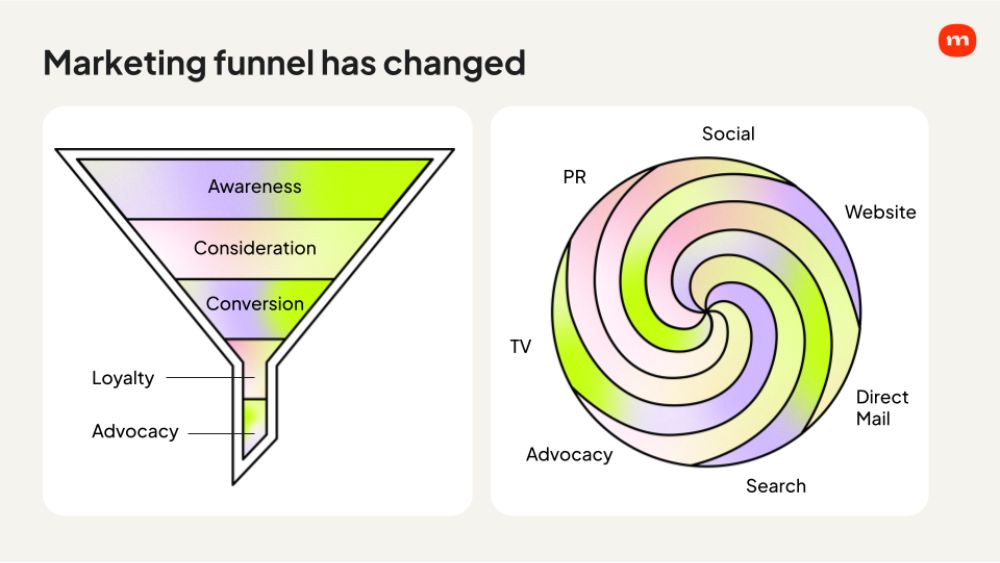
Due to fragmented journeys and an increased number of channels users interact with, the path a supporter takes is no longer linear. Instead, supporters may enter the journey at any stage, a complexity escalated further by the emergence of AI search.
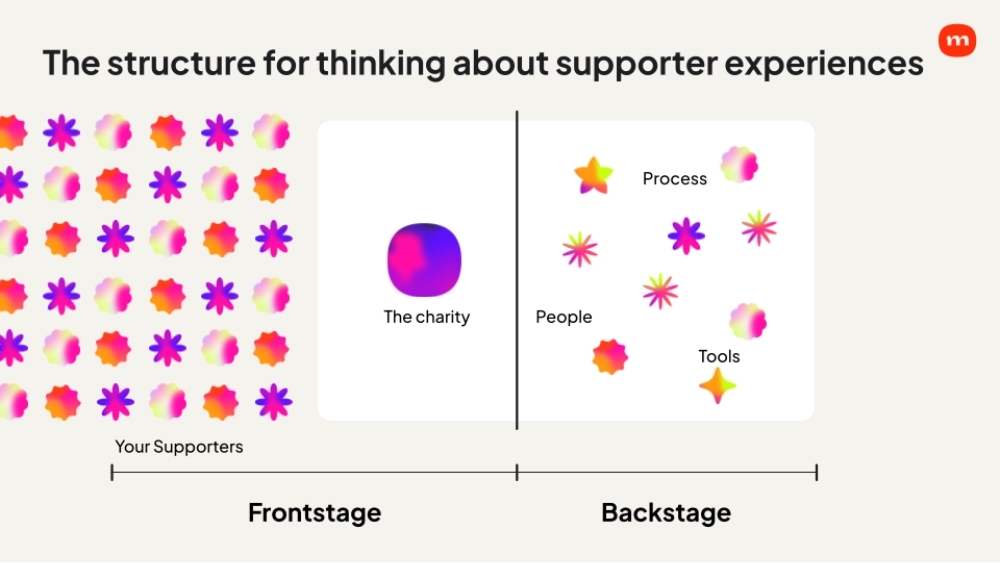
One way charities can tackle this complex scenario, is by adopting a service design concept known as Frontstage and Backstage, which is aimed at solving real Customer Experience problems.
In any transaction, there are aspects of the experience that a customer interacts with (Frontstage), and the aspects they do not (Backstage). For supporters interacting with charities, the Frontstage experience is any touchpoint that is designed to inspire action through donation, volunteering, or advocacy.
Backstage refers to the infrastructure needed to deliver supporter experiences at scale. This could be a combination of the people, processes, tools, and technology that create a smooth and seamless Frontstage experience.
The best experiences occur when frontstage and backstage operate in harmony, whether online or offline.
In terms of AI, it should only be used in Frontstage and Backstage processes, if it delivers tangible value, and improvement, to the overall supporter experience.
With the Frontstage, this could mean addressing moments of supporter frustration that contribute to drop off rates. In the Backstage, it means solving any processes that contribute to the frustrations that can surface in the Frontstage interaction.
Below we provide some ideas for the practical application of AI, to both Frontstage and Backstage processes.
AI is fundamentally changing how audiences interact with organisations online. This is particularly evident in the way AI search results and overviews are impacting day to day internet browsing, which is causing brands to rapidly lose control over their digital storefronts. By 2030, predictions indicate that AI traffic will surpass traditional organic traffic.
While AI summaries might provide quick answers and raise awareness, they pose significant risks for charitable organisations. AI-generated information is often inaccurate, which has serious implications for the beneficiaries and supporters of charities aimed at people with serious medical conditions. This issue is further complicated by search results frequently drawing heavily from US guidance, rather than UK/NHS standards, leading to potentially inappropriate advice for protected populations. Crucially, AI summaries fail to highlight the ‘wraparound care’ offered by charities; including access to specialist nurses, peer support, or active patient forums. The end result leaves users unaware of comprehensive support services available.
To counteract the vanishing visibility caused by AI search, charities must think about developing Generative AI Engine Optimisation. Additionally, they should incorporate interactivity into their websites that AI cannot replicate. For example, a prostate cancer charity used a beautiful risk checker on its website, requiring its audiences to use the tool on its website, thus circumnavigating the reliance on AI summaries.
Currently, the best use of AI lies in improving internal processes, to deliver experiences at scale. The industry is moving towards AI tools that can receive context and instructions and run autonomously. While this is not yet possible without a human facilitator, Gartner predicts that AI will handle 15% of all marketing tasks by 2028. Charities will gain the most from AI by using it to solve internal inefficiencies, painful administrative tasks, and manual work.
Scaling support services: Breast Cancer Now (BCN) is exploring how AI can help draft the first response to its "Ask Our Nurse" inquiries.
The AI model drafts the response based on a vector database of previous answers and published health information to ensure technical accuracy, though two qualified cancer nurse specialists still check the response. The long-term goal is to refine the model until confidence is high enough to potentially remove one human check, allowing the service to scale its offer.
Improving matching accuracy: In the "Someone Like Me" peer support offer, BCN staff currently spend up to half a day selecting the right volunteer from a pool of 600 based on 140 data points. AI is being considered to conduct the initial sweep to create a shortlist, potentially leading to a more "organic match" by picking up on sensitive individual factors (such as the death of a mother, religion, or number of children).
Automating workflow and prioritisation: Working with the RNIB’s integrated marketing and engagement function, AI is being used to operationalise processes.
This includes:
Brief sense-checking - AI reads marketing briefs, checks if all required fields are collected, and then prompts the sender via Teams to fill in missing details, such as campaign objectives
Workflow automation- the AI senses different requests (small scale versus engagement journeys) and automates the necessary workflows and steps, notifying the right people
Prioritisation tool - An AI-powered tool uses a three-step model to score tasks based on alignment with strategic goals, marketing/engagement goals, and in-house capacity/capability, before humans make the final go/no-go decision
As the use of AI increases and becomes normalised as part of our work, it is crucial to remain ethical and human-centred. As Joseph Weizenbaum suggested, ‘we should never substitute a computer system for a human function that involves interpersonal respect, understanding and love.’
Environmental impact: The energy consumption of AI data centres is projected to equal the entire energy usage of Japan by 2030. Charities must be conscious of this environmental impact, and guarantee that their investment in AI is measured, and justified, by the value delivered to their beneficiaries.
High failure rates: Enterprise AI often does not provide a return on investment, with 95% of projects reportedly failing (MIT report). Gartner predicts that 45% of autonomic projects will have failed by 2027. WIth this in mind, it is essential that the adoption of AI tools or processes, is thoroughly considered in terms of its use, and potential impact. If the cost outweighs the impact, other options might be safer and more effective.
The human factor: AI projects often fail because human factors are not considered. Since Generative AI provides answers with equal confidence whether they are correct or clearly incorrect (hallucinations), humans lose trust and spend time double-checking the results. This excessive checking eliminates the productivity gains that AI was supposed to deliver.
Charities must approach AI adoption with curiosity, care, and critical thinking. Learning should be experimental, human-led, and performed before being applied to live projects. This prevents any serious impact on beneficiaries, supporters, or organisations, should any mistakes occur during experimentation.
The application of AI in supporter journeys is like adding a sophisticated GPS system to an established postal route. The old route (the linear funnel) was reliable but slow. The new environment (the swirl) is complex and constantly shifting. AI (the GPS) doesn’t just speed up the internal sorting process (Backstage) but also helps ensure the crucial destination—the supporter experience (Frontstage)—is reached effectively, provided we ethically guide the technology and focus on solving problems that truly matter to both staff and supporters.
Manifesto, part of B Corp accredited TPXimpact, creates transformative digital experiences for purpose-led organisations. We are the trusted digital partner for global charities, membership organisations, public sector and cultural leaders, including UNICEF UK, Save the Children, ZSL, BACP and University of Birmingham. We bring together human-centred design, data, and technology to help these organisations grow with confidence and deliver lasting impact. Learn more at manifesto.co.uk.





Our courses aim, in just three hours, to enhance soft skills and hard skills, boost your knowledge of finance and artificial intelligence, and supercharge your digital capabilities. Check out some of the incredible options by clicking here.

© 2022 Charity Digital Trust. All rights reserved